Both cats explore each other’s spaces freely, scent swapping sessions pass without tension, and the resident cat has stopped pacing anxiously outside the isolation room door. Now comes the moment many caregivers have been waiting for – the cats will see each other for the first time. But that doesn’t mean it’s time to fling the door wide open. Contact through a barrier is the stage that ensures this first glimpse happens safely – for the cats and for you.
What Is Contact Through a Barrier?
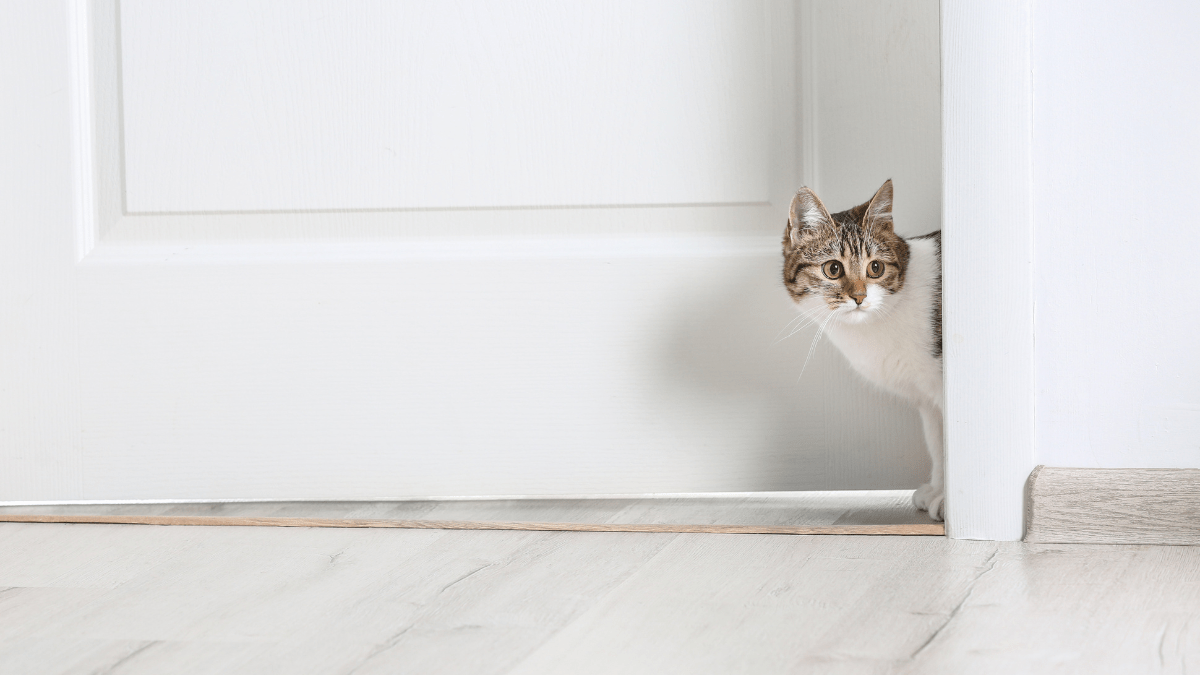
Contact through a barrier is the stage of cat introduction in which cats see each other for the first time – but a physical barrier prevents any direct contact. This can be a screen fitted into the doorframe, a children’s safety gate, a door cracked open and held with a stopper, or a specially designed door latch with an adjustable gap.
The goal of this stage is to:
Allow cats a safe first visual contact
Build positive associations with the sight of the other cat
Observe both cats’ body language in controlled conditions
Gradually prepare for the first meeting without a barrier
When Can You Start Contact Through a Barrier?
Moving to this stage is justified when:
Room swapping has been proceeding calmly for at least several sessions
Both cats willingly explore each other’s spaces
The new cat is relaxed and confident – eating, playing, and resting without signs of chronic stress
The resident cat shows no strong arousal or aggression in response to the new cat’s presence behind the door
If any condition is not met – return to room swapping and scent work. Rushing at this stage costs weeks of behavioral work.
How to Prepare the Barrier?
The barrier must meet several basic requirements:
Stable and impossible to knock over – an aroused cat may attempt to force it; if it succeeds, the first meeting becomes a conflict
Visible but not transparent at the bottom – a screen works better than a cracked door through which cats can swipe at each other with their paws
Leaving room to retreat – neither cat should find itself with no way to move away from the other cat’s line of sight
Popular solutions include children’s safety gates with mesh, doors fitted with garden netting, or specially designed latches with adjustable gaps.
How to Conduct the First Session?
Step 1: Tire the Cats Out Before the Session
Before every barrier session, play with each cat separately – an intense 10–15 minute wand toy session reduces arousal and leaves cats calmer during the encounter.
Step 2: Prepare Treats
Barrier contact must be associated exclusively with something pleasant. Prepare both cats’ favourite treats. Offer them on both sides of the barrier – so the cats eat simultaneously while seeing each other.
Step 3: The First Seconds
The first session should last literally a matter of seconds. Open the barrier briefly, offer treats, observe reactions, and end the session before either cat has a chance to tense up. It is always better to finish too early than too late.
Step 4: Gradually Extending Sessions
With each subsequent session – provided the cats are calm – gradually extend the duration of visual contact. Don’t set a rigid schedule; what matters is the quality of the reactions, not the number of minutes.
Step 5: Ending the Session
Always end the session while both cats are still in a calm state. Finishing on a positive note reinforces a good association with the sight of the other cat.
What to Look For During Sessions?
Positive or neutral reactions:
Calm sniffing towards the barrier
Walking away and returning of their own accord
Eating treats in the other cat’s presence
Rubbing against the barrier (allomarking)
Soft, curious eye contact
Signals requiring a slower pace:
Stiff posture, unblinking stare
Hissing, spitting, growling
Attempts to swipe through the barrier
Fleeing and hiding after the session
Loss of appetite following the session
If you observe reactions from the second group – shorten sessions, increase the distance between the cats during feeding, or return to the room swapping stage.
Distance Matters
You don’t need to place the food bowls right at the barrier from the very first session. Start with greater distance – each cat eats at its bowl several metres from the barrier, seeing the other cat in the background. With each subsequent session, move the bowls closer to the barrier – slowly and steadily. This technique is known as desensitization through approximation and is one of the most effective behavioral tools when working with cats.
How Many Sessions and How Long?
The barrier contact stage typically lasts 1 to 4 weeks, with sessions conducted once or twice daily. You can move to the first meeting without a barrier when:
Both cats eat calmly close to the barrier for several consecutive sessions
There is no hissing, growling, or body tension
Cats willingly approach the barrier and do not avoid eye contact
Signs of interest without arousal appear – such as rubbing against the screen
Most Common Mistakes at This Stage
Moving to this stage too early – when cats are not yet ready, the first glimpse becomes a trauma
No rewards – visual contact without positive reinforcement builds no good association
Sessions that are too long – fatigue and arousal promote conflict
Leaving cats unsupervised at the barrier – always stay present and attentive
Forcing contact – bringing a cat to the barrier against its will sets the entire process back
Ignoring stress signals – every hiss is a message, not a whim
Contact Through a Barrier and Cats With Trauma
Cats from shelters, with a history of aggression, or with difficult past experiences with other cats may need a significantly longer barrier contact stage. In such cases, it is worth consulting a behaviorist before moving to a free meeting – one poorly conducted encounter can entrench hostility for many months.
Your cats are standing on opposite sides of the screen staring at each other without blinking? Not sure whether that’s curiosity or a threat? Contact me – I’ll help you read your cats’ body language and plan the next steps safely.